Jun 25, 2026
A Warning Label I Earned
If you searched “Wayne Boatwright attorney” or “Wayne Boatwright DUI,” you are likely trying to answer a fair question: who is this man, and what should I know before I trust him?
Here is the answer without fog.
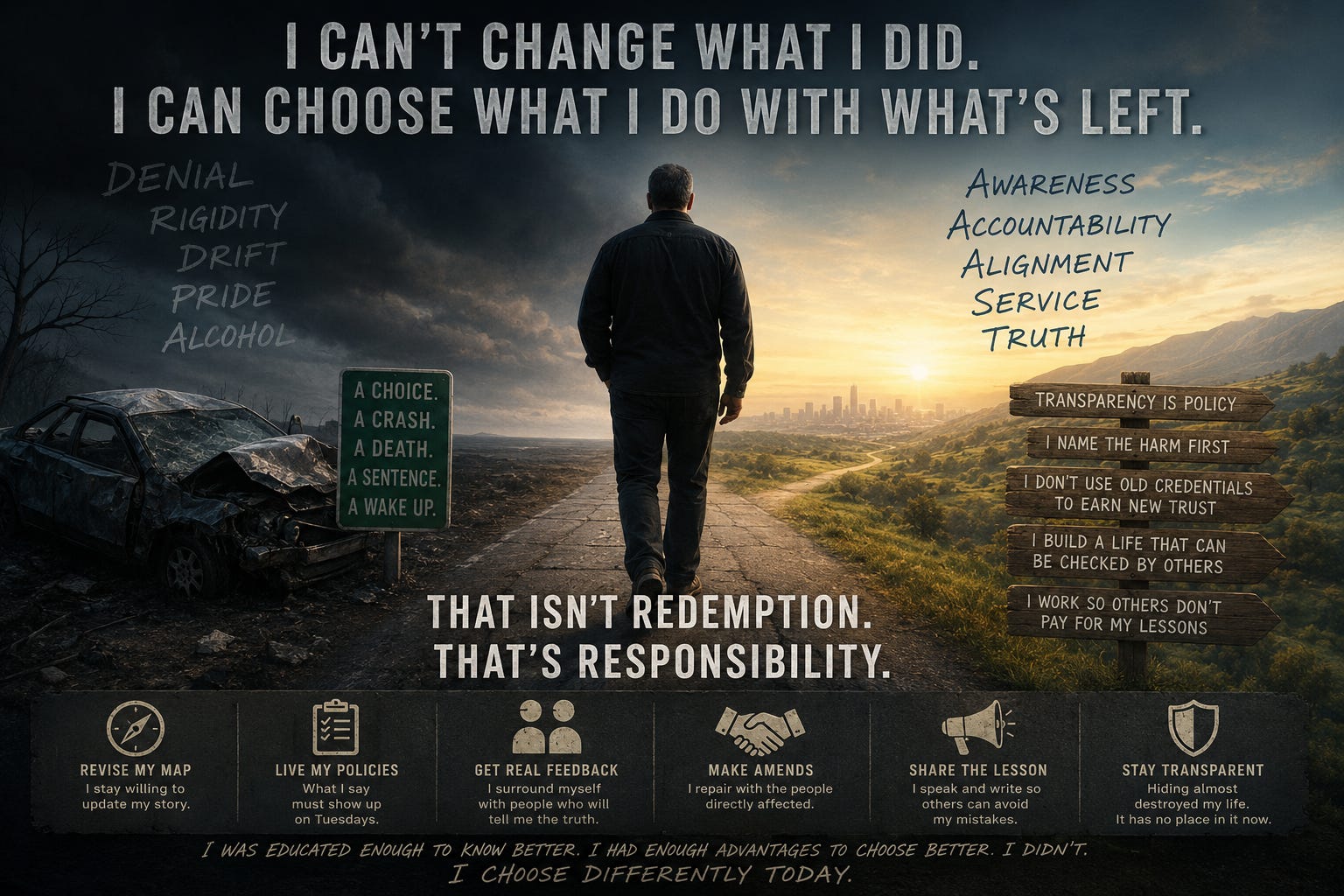
I was an attorney. I am not practicing law. My legal career ended because of my own conduct. I drove drunk, caused a fatal crash, went to prison, and came home to a life that could not be rebuilt by résumé language, charm, silence, or clever explanations.
A woman died because of my choice. Another person was harmed. Families were changed. My own family was changed. That is the center of the story. Not my education. Not my former profession. Not the pain I was carrying. Not the work I have done since. Those things may explain context. They do not excuse the act.
For years before the crash, my reality, my self-story, and the signals around me were no longer matching. I had a life that looked successful from the outside, a map in my head that said performance justified neglect, and a nervous system that had been objecting for years while I called it “stress” and kept driving. I did not have a usable operating system for revising that map before reality did it for me by force. That gap is not a defense; it is the exact failure I live with, and work on, every day.
I knew enough to suspect something was wrong and maintained my story anyway because updating it would have cost me status, comfort, and an identity I was attached to. In my longer work, I call that defensive rigidity: choosing to treat clear internal and external signals as an inconvenience instead of information until harm makes denial impossible. The crash did not appear out of nowhere. It was the end of a pattern I refused to revise.
That distinction matters.
The internet is very good at compressing a life into a label. “Ivy League attorney.” “DUI.” “San Quentin.” “Redemption story.” Those phrases are searchable, and they are not false, but they are too thin to carry the moral weight of what happened. A podcast title can point at the event. It cannot do the harder work of living under it.
This page exists because I would rather you hear the hard facts from me than watch me hide behind the soft blur of reputation management. I am not trying to outrun the search results. I am trying to stand where they point.
Privacy is not always the problem, but for me, hiddenness was part of the old operating system. Too many of my worst decisions grew in spaces where I could keep my image intact while my reality deteriorated. That is why transparency has to be more than a page. It has to be a constraint.
Transparency, for me, is not confession as performance. It is policy. In the rest of my work I describe policy as a one‑sentence rule that changes what actually happens on Tuesdays, not just how you talk about yourself. One of my non‑negotiable policies now is this: I name the harm first, I do not let old credentials do work they no longer deserve to do, and I do not ask anyone to extend trust without the information that might reasonably change their mind.
It also means I refuse the lazy opposite: becoming only the worst thing I have done. That may satisfy outrage, but it does not serve truth. A person can be fully responsible for irreversible harm and still have the duty to live differently after it. In fact, that duty is the point.
Practically, that looks less dramatic than it sounds. Every week I sit down and name one signal my body has been sending that I have been tempted to ignore, one promise I am actually going to keep, and one conversation I owe because someone else’s map of me needs an update. Once a month, I do a one‑page review of the previous thirty days: where my time really went, where my actions contradicted my stated values, and which belief about myself or my life is clearly out of date. These are small, boring practices. They are how I prevent myself from drifting back into the kind of life where I call warning signs “stress” and let other people pay for my unexamined story.
I also do not rely only on my own self-assessment alone. Part of accountability is giving other people permission to tell me when my story and my conduct are separating again. I keep relationships in my life where hard feedback is not treated as betrayal, and I build commitments that can be observed by people other than me. Private insight is not enough. The version of me that caused harm was also capable of sounding reflective. What matters now is whether my life can be checked against reality by people who are not invested in protecting my image.
Since coming home, my work has focused on decision‑making, accountability, emotional regulation, prison reentry, family repair, and the hard mechanics of rebuilding trust. I write and speak about these things because I know what happens when a person has intelligence without self‑command, ambition without honest feedback, and pain managed through alcohol instead of truth. I also know what happens when you ignore capacity, say yes past the point of honesty, and let drift run your life until your body protests in ways you can no longer rename.
I am not practicing law. I do not present myself as someone whose credentials erase what happened. I do not use this story to ask for sympathy, and I do not treat pain as a substitute for responsibility. When I speak or write, the point is not to make the past inspirational. The point is to make the pattern visible before it becomes irreversible in someone else’s life.
That is not a brand. That is a warning label I earned. I call it a warning label because what I teach now is not abstract resilience. It is the unglamorous mechanics of what happens when you let overload, drift, and unchallenged stories run your life until other people absorb the damage. My work on maps, operating systems, and capacity exists because I became dangerous in exactly those ways, and I do not want to outsource that lesson to anyone else’s life.
So if you searched “Wayne Boatwright DUI,” yes, you found the central wound in my life. If you searched “Wayne Boatwright attorney,” yes, you found the former identity that makes the fall sharper. I was educated enough to know better. I had enough advantages to choose better. I did not.
What I can do now is tell the truth, keep telling it, and build work that may help someone else interrupt the pattern before it becomes damage. Part of that work is personal—how I design my days, what I say yes to, how I repair with the people directly affected. Part of it is public—how openly I talk about harm, responsibility, and the operating systems we either build on purpose or inherit by accident.
You do not owe me trust. You are free to weigh the facts, the harm, the record, the work since, and your own judgment. That is exactly what you should do.
Transparency does not erase the past. It makes hiding harder. For me, it is one component of a larger operating system: I keep revising my map, my policies, and my relationships in full view of the people whose lives are woven with mine, because privacy was where too many of my worst decisions flourished. That is why I am transparent.