May 15, 2026
Curation: From Turntables to Training Data
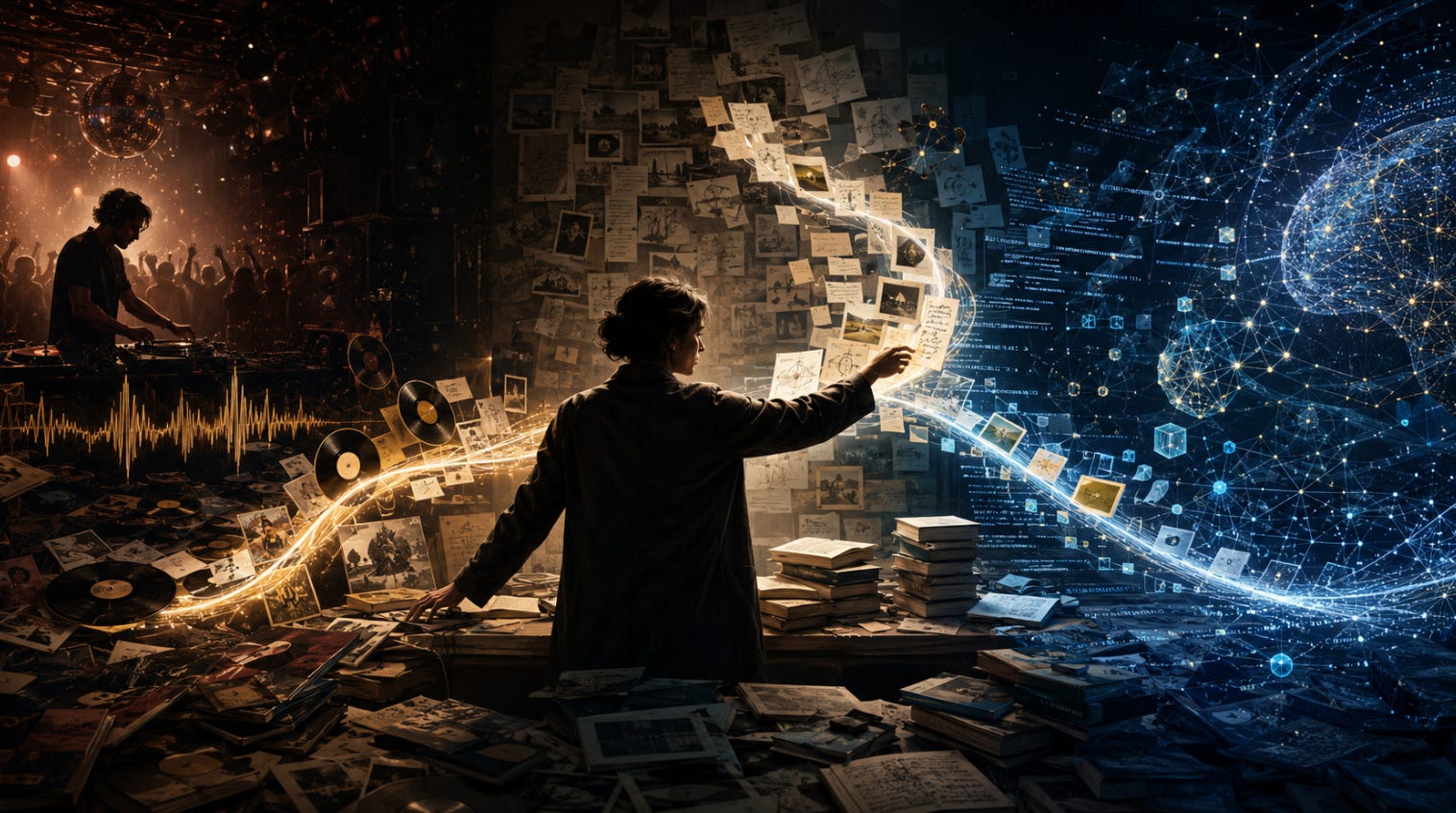
The First Curator
The DJ looked, for a long time, like one of the least creative people in the room. He did not write the songs. He did not sing them. He often did not even speak in full sentences. He stood between two turntables, or later behind a wall of glowing machinery, and played other people’s music. If you wandered into a radio station in the 1930s or a dance hall decades later, you might have mistaken him for a musical traffic cop, someone whose job was simply to keep the records moving.
But that was never really the job. The job was to decide what mattered next.
That sentence contains more of the modern world than it first appears to. In a culture of scarcity, creativity often meant making what did not yet exist. In a culture of abundance, creativity increasingly means deciding what deserves to be noticed, trusted, sequenced, and passed forward. The DJ matters because he stands at the beginning of that shift. He is not merely playing records. He is rehearsing the central problem of the information age.
When Attention Became the Scarcity
That is a much stranger job than it sounds. Once recorded music became abundant, and then absurdly abundant, the real scarcity in the room was no longer songs. It was attention. Someone had to choose from the growing pile of available tracks, decide what fit the moment, sense when the room was ready for surprise and when it needed relief, and arrange all of it into something that felt less like a playlist than a journey. The history of DJ culture is, in that sense, the history of a new kind of intelligence: not the intelligence that produces raw material, but the intelligence that selects, sequences, and reframes it.
Selection as a Second Form of Creation
This does not mean invention disappears. It means invention now competes with a second form of creativity: the power to structure abundance into meaning. A new song can still matter. A new theory can still matter. But once the archive becomes too large for any mind to hold, the person who can arrange the archive begins to shape reality almost as much as the person who adds to it.
From Selector to Curator
The first disc jockeys on radio were selectors in the most literal sense: they introduced records, managed transitions, and shaped the listening experience for audiences with limited access to music. But as music culture evolved through Jamaican sound systems, hip-hop, disco, house, and digital club culture, the DJ became more than an announcer. He became an editor of collective emotion. In Jamaica, selectors built scenes around choosing the right record at the right moment. In the Bronx, hip-hop DJs turned turntables into instruments by isolating breaks and extending rhythms. In disco and house, beatmatching transformed the DJ from someone who played tracks into someone who erased the seams between them.
At some point, without anyone quite announcing it, the DJ became a curator.
That word matters. A curator does not make all the objects in the museum. A curator decides which objects belong together, in what order they should be encountered, and what frame turns each object into part of a larger meaning. The DJ was doing this with records long before “curation” became a bit of corporate jargon. He was taking an expanding archive of recorded sound and imposing form on it. He was saying, in effect: not everything deserves equal attention; this, now, is what matters.
That is why the DJ turns out to be more important to the history of digital culture than he first appears. He was one of the earliest modern figures whose creativity came primarily from selection rather than invention. The songs were not his. The structure was. The emotional arc was. The sense that this track belonged after that one, and that neither would mean the same thing in isolation, was.
Once that becomes clear, an odd thought follows: the DJ may have been one of the first highly visible practitioners of what now governs much of modern life, the art of curating abundance.
The Three Disciplines of Curation
To see why this matters beyond music, the DJ’s intelligence has to be broken into three disciplines: cutting, learning, and updating. One is what might be called the Knife: a mental tool for cutting through clutter, confusion, and seduction by noise. The Knife is the discipline of separating signal from distraction, evidence from theater, and what matters from what merely shouts loudest. Another is Positive Error Culture: the habit of treating mistakes as useful feedback instead of humiliations to be concealed. In any real decision-making environment, errors are not proof that thought has failed; they are how thought improves. A third is the mathematics of rationality: not literal equations on a page, but a structured habit of breaking problems into parts, weighing evidence, updating beliefs, and adjusting to new information instead of clinging to old narratives.