Jul 10, 2026
Feelings Are Data. Stop Treating Them Like Orders.
A Noise Worth Hearing
A good mechanic does not panic when an engine makes a strange noise. The mechanic listens. The sound is not the failure; it is information about what needs attention.
Most of us are less skilled with emotions. We panic, react, distract ourselves, or turn up the mental radio and hope the noise disappears. Then we act surprised when the system breaks down.
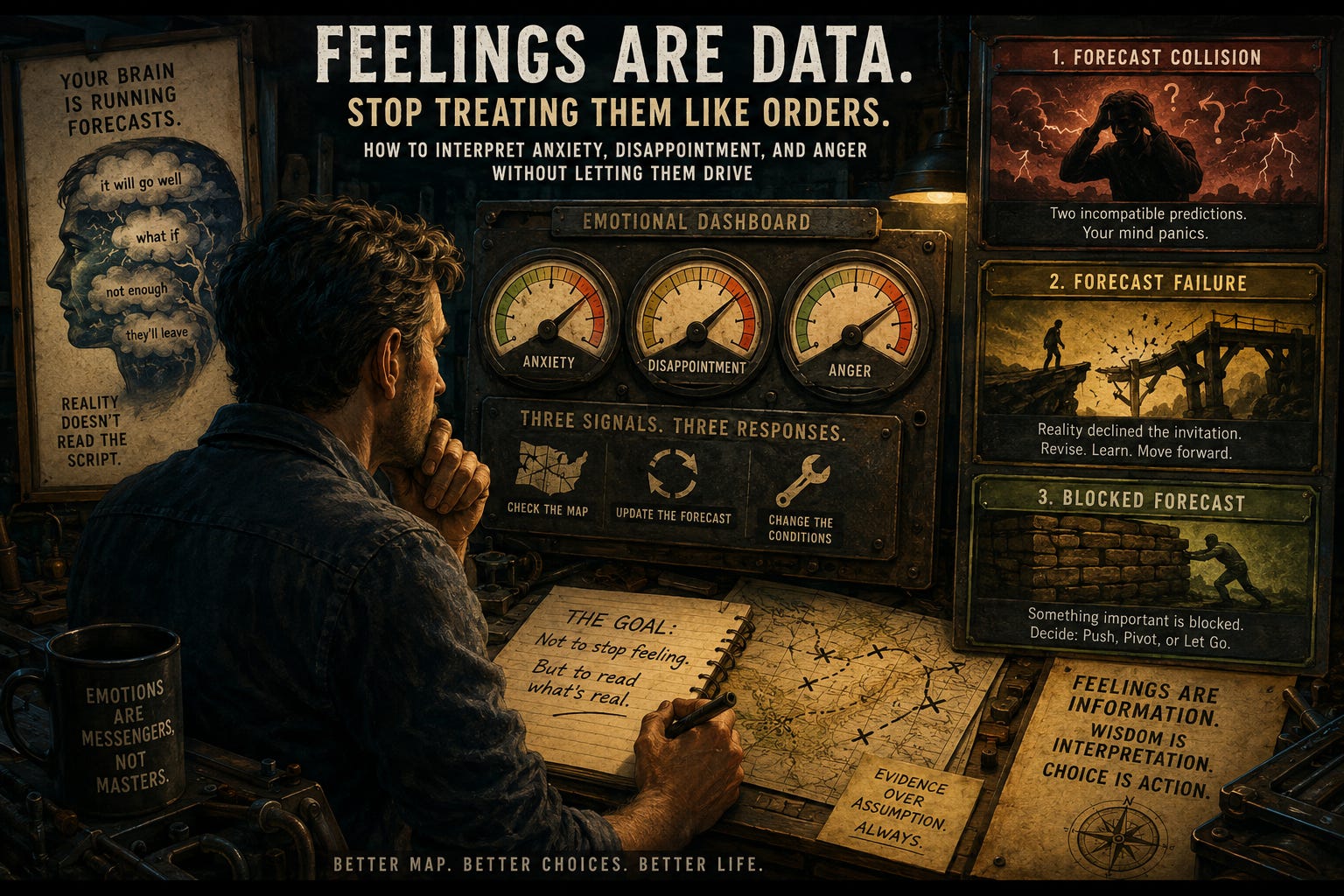
But anxiety, disappointment, anger, and shame are not verdicts. They are dashboard lights. Each points to a different mismatch between the world we expected and the world we encountered. Read the wrong signal, and you may solve the wrong problem. Read it accurately, and emotion becomes data.
Chapter 13 of The Wheel and the Weave offers a practical way to make that shift: from panic to diagnosis, from reaction to response, and from “something is wrong with me” to “something in my map may need updating.”
Your Brain Is Running Forecasts
Your nervous system is always predicting what comes next.
This person will respond kindly. That meeting will go badly. If I ask for help, I will look weak. If I work hard, I will be rewarded. You do not sit down each morning and draft these forecasts. Your Elephant, the fast and automatic part of your mind, runs them in the background.
Then reality arrives and, with its usual lack of manners, ignores the script.
When reality and prediction do not match, your nervous system sends an alert. The alert may be anxiety, disappointment, anger, shame, or some messy combination. The feeling is real. But the feeling is not always a faithful description of the world.
Sometimes reality is more dangerous, kinder, or more complicated than you expected. Often, though, the forecast is old, too broad, or based on evidence from another time and place.
Before you revise the forecast, check the environment.
Some alarms are outdated. Some are accurate. Anxiety can come from an old map, but it can also report a real threat. Anger can come from a blocked preference, but it can also reveal a violated boundary. Disappointment can expose an inflated expectation, but it can also follow a genuine betrayal.
The goal is not to distrust emotion. It is to locate the mismatch.
Is the problem in the forecast, in the world, or in both?
If the forecast is old, update the map. If the danger is current, protect yourself, seek support, or change the situation. If both are true, revise the map without pretending the terrain is safe.
The question is not, “How do I stop feeling this?”
The better question is, “What is this feeling reporting?”
Chapter 13 sorts emotional distress into three common signals: forecast collision, forecast failure, and blocked forecast. Each points to a different problem. Each calls for a different response.
Signal 1: Forecast Collision
What it is: Two incompatible predictions are running at the same time.
How it feels: Anxiety, panic, urgency, mental looping, and the sense that something must be solved immediately, even when the room is safe.
Sarah felt panic whenever she considered asking her partner for reassurance. Beneath the panic were two forecasts:
“I need reassurance to feel secure.”