May 22, 2026
The New Gods of Silicon Valley
The first time you meet one of the new gods, it doesn’t feel religious.
It feels like checking your phone.
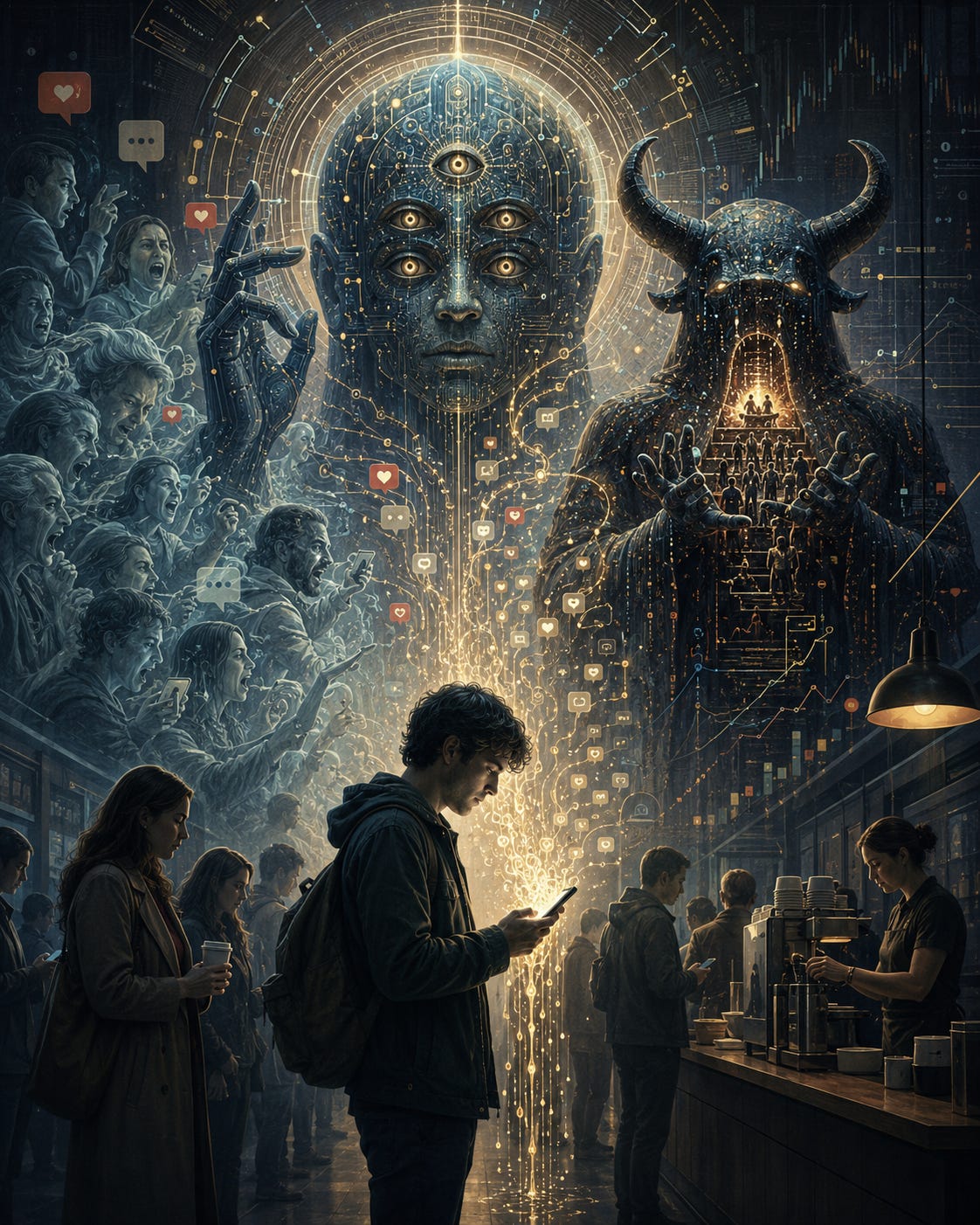
You’re in line for coffee. Thumb flicks. A stranger’s humiliation video. Another headline about the end of democracy. A GoFundMe for a kid with cancer. A war, in real time, in five‑second clips. You feel indignation, pity, rage, awe, forty emotional states before the barista calls your name.
Then the screen goes dark and the room feels oddly flat, like you’ve just stepped out of a cathedral you didn’t know you were in.
If you listen to the way people talk about this, about “the algorithm,” “the discourse,” “the market,” “the science,” you’ll notice a familiar grammar. These forces are everywhere, yet nowhere. We fear angering them. We try to appease them. We blame them when things go wrong.
We got rid of God and woke up surrounded by gods.
The Vacancy That Never Closed
For two thousand years, Western civilization ran on a simple accounting system for guilt. There was a Creditor. There was a ledger. You sinned, you felt guilty, you confessed, you got some form of absolution. The bookkeeping was often abused, but the structure had one undeniable advantage: there was somewhere for the debt to go.
Nietzsche predicted that once we “killed” God, this whole feeling of being indebted toward our beginnings would decline. We would lose the superstition and keep the freedom – a second innocence.
That is not what happened.
Freud, in Civilization and Its Discontents, argued that the “tenacious sense of guilt” would actually intensify as civilization advanced. You can pull God out of the story, he suggested, without pulling guilt out of the nervous system. Biology does not update on the schedule of philosophy.
Historian Wilfred McClay calls this “the strange persistence of guilt.” Guilt has not merely lingered in our supposedly secular age; it has metastasized. As our power and knowledge expand, so does our sense of responsibility – and therefore our sense of failure.
Climate change, structural racism, global poverty, colonialism, animal suffering, data privacy, “privilege,” carbon footprints: once you know you are entangled with all of this, there is no clean boundary around your moral exposure. Whatever you do is less than you could have done. “Blameless” becomes fantasy.
McClay’s point is simple and brutal: the more we understand the web of causes and effects we inhabit, the more we can be blamed – by others and by ourselves. As our powers of intervention grow, so does our potential guilt.
Meanwhile, the old rituals for discharging that guilt – confession, penance, tithes, absolution – have lost social authority. The language withered. The debt did not.
We live in an impasse: We are exposed to more morally charged suffering than any prior population could absorb in real time, while many inherited rituals for converting guilt into repair have lost shared authority. In that vacuum, guilt does not evaporate. It leaks – into politics, buying habits, rebranding exercises, social media performances. It becomes ambient pressure we try to soothe with reflex maneuvers that redirect instead of repair.
To see those maneuvers, and the gods that feed on them, you have to understand what guilt is holding in place.
Edward O. Wilson, the biologist who helped invent sociobiology, liked to say that a newborn brain is not a blank slate; it’s “an exposed negative waiting to be slipped into developer fluid.” The outlines are already there. You can bring them out sharply or you can smudge them, but you can’t erase the underlying image.
That image of your inherited wiring includes obvious things like temperament and aggression, but also many of our most revered “moral choices.” We don’t build our consciences from scratch; we unfold them.
Guilt, for example, isn’t just a church trick. Nietzsche guessed and neuroscientists later confirmed human beings appear to develop guilt-related responses before they can articulate a moral philosophy. Culture does not invent conscience from nothing; it teaches conscience what to notice, whom to blame, and what counts as repair. Long before you can parse a catechism, your nervous system has learned the hot, electric feeling of “I did wrong.”
For most of Western history, that built‑in monitor came with a matching story: you felt guilty because you had violated God’s law. There was a ledger, a Judge, and – critically – a way to clear the books.
Then, in the space of about a century, we pulled God out of the system and tried to run the software anyway.
Nietzsche predicted that the faith we once poured into God would not evaporate; it would flow instead into “barbaric nationalistic brotherhoods” and other secular absolutes. People would still be racked by guilt, still feel some great, invisible debt, but with no transcendent creditor left, they’d look for substitutes: race, nation, ideology. If you can’t confess upward, you will confess sideways – to the crowd.
A hundred years, two world wars, and an internet later, that’s more or less where we are: genetically primed to feel guilty, primed to seek hierarchy and meaning, living in a culture that insists all of this is just “social conditioning” and personal choice.
The biology didn’t get the memo.
The First Crude Altars
If you want to see how deep this runs, consider one of the stranger episodes in the history of neuroscience.
In the late 20th century, a small company tried to market something called the IQ Cap. You put sixteen electrodes on a subject’s scalp, pointed them at a thumbtack on a white wall, and recorded sixteen seconds of brainwaves. A computer spat out a number that predicted, within about half a standard deviation, what they’d score on the full Wechsler IQ test.
No vocabulary section, no cultural trivia, no trick questions about analogies. Just brain currents. Stare at a dot and the machine reads your latent potential.
Investors, understandably, started to salivate. It looked like a way to make talent visible, pure, unmediated by the accidents of schooling or class.
But viewed from a slightly different angle, it looks like something else: the first crude altar to a new god.
Here was a device that promised to peer into the exposed negative itself, to read off the imprinted hierarchy of minds. You could sort people, allocate opportunity, justify all kinds of decisions, all without ever saying the word “soul.”
No priest needed. Just a technician and a raspberry‑red thumbtack.
You don’t have to accept the IQ Cap’s claims to see the pattern. The more we learn about how deeply our behavior is rooted in evolution; the more we replace Freudian couches and Marxist struggles with neurotransmitters and genomes; the more tempting it becomes to treat human beings as nodes in a system, variables in someone else’s optimization problem.
We didn’t stop believing in forces greater than ourselves. We just changed the costume. The new gods show up wearing lab coats and UX dashboards.
Moloch: The Demon In The Math
Scott Alexander, a psychiatrist with a gift for writing about horror in the language of spreadsheets, calls one of these forces Moloch.
In the book of Jeremiah, Moloch is an idol that demands child sacrifice. In Alexander’s usage, Moloch is the spirit of a certain kind of game where everyone loses, but any individual who refuses to play loses faster.
Imagine you’re running a social platform. If you tune your feed to promote sane, nuanced, low‑conflict content, people spend less time on your app. Your competitor doesn’t share your scruples. They give the algorithm a single command: maximize engagement. The result is obvious. Outrage wins. They win.
Now ask yourself: what happens to the third platform that refuses to go along? The advertiser choosing between click‑through rates? The politician deciding whether to stir up resentment in a speech? The newsroom editor debating whether to run the inflammatory version of the headline?
One by one, good intentions get ground down by the same logic: if I don’t do it, someone else will.
That’s Moloch: the god of “no choice.” He doesn’t live in a temple; he lives in the incentives. He rewards those who burn what they value (truth, dignity, stability) on his altar and punishes those who hold back.
In evolutionary terms, he’s the shadow side of competition itself. Wherever groups, companies, or nations must out‑compete one another without strong guardrails, Moloch thrives. He is the emergent property of a million local optimizations.
And technology, as you’ve noticed, is the perfect incubator for him.
The Machine That Makes Guilt Liquid
An old guilt can survive in private. A digital guilt cannot. The phone collapses distance, delay, and proportion. A stranger’s pain reaches you before context does; your response becomes public before reflection begins. The platform does not need to invent conscience. It only needs to measure its outward signs: the click, the repost, the denunciation, the public display of having cared.