Apr 3, 2026
The Day I Realized “Trying Harder” Was the Problem
Capacity is the part of your fabric that quietly decides which futures you can actually live in, not just fantasize about while drinking expensive coffee and lying to yourself. Chapter 22 is where we stop pretending you are a limitless beam of light trapped in a disappointing calendar and start dealing with the awkward truth: you are a finite creature with a body, a nervous system, a bank account, and only so many clean shirts.
My life blew up in ways dramatic enough to keep therapists employed for generations, but the part that nearly finished me off looked boring from the outside. After the crash, after the trial, after prison, came the long, humiliatingly ordinary work of rebuilding. Work. Fatherhood. Repair. Sobriety. Grief. Bills. Showing up for people who had every reason to look at me like a smoke alarm that had already failed once.
If you had listened to my self-talk back then, it sounded noble. Practically sainted.
“I owe everyone everything.”
“Given what I’ve done, I don’t get to say no.”
“If I still have bandwidth, I should use it.”
Very moving. Very moral. Also completely insane.
Underneath all that lofty language was a less flattering reality: I was stuffing my days like a raccoon trying to shoplift an entire pantry. I kept calling it responsibility when it was really panic wearing a tie. The cruel little joke was that the part of me trying so hard to make things right was quietly creating fresh damage, one overpromise at a time.
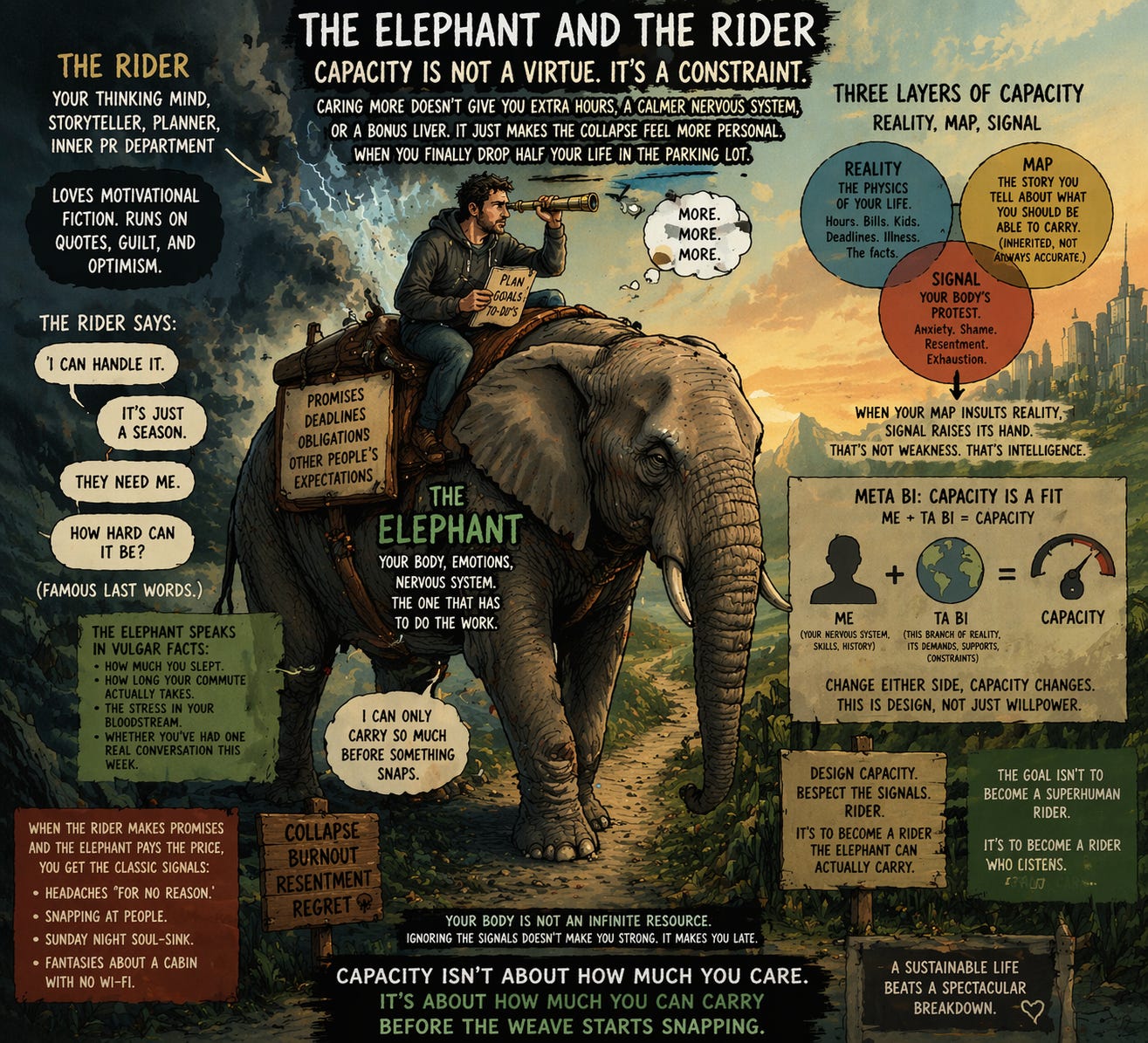
That is where this chapter begins, with a sentence I did not want to write: capacity is not about how much you care. It is about how much you can carry before the weave starts snapping like cheap elastic. Caring more does not give you extra hours, a calmer nervous system, or a bonus liver. It just makes the collapse feel more personal when you finally drop half your life in the parking lot.
Elephant, Rider, and the Delusion of Infinite Me
By now you know the two main characters. The Elephant is your body, your emotional system, the great lumbering beast that actually has to live your life. The Rider is your reflective mind, your narrator, your inner PR department. Chapter 22 asks a rude but necessary question: what happens to capacity when the Rider makes promises and the Elephant is the one left dragging them uphill?
The Rider loves motivational fiction. It feeds on quotes, productivity sermons, leadership podcasts, childhood conditioning, and the deeply American belief that exhaustion is a personality trait. It sets capacity with lines like:
“I can handle it.”
“It’s just a season.”
“They need me.”
“How hard can it be?” — a sentence with one of the highest body counts in human history.
The Elephant, meanwhile, sets capacity with vulgar little facts:
How much you slept.
How long your commute actually takes.
How much stress is marinating in your bloodstream like a cursed broth.
Whether you’ve had one real conversation this week or just a series of logistical hostage negotiations.
Capacity fails when the Rider does math using optimism, guilt, and vibes, and the Elephant files its complaints directly into your flesh. That is when you get the classic symptoms:
Headaches “for no reason.”
Snapping at people who did not deserve it.
That Sunday-night feeling like your soul is being slowly faxed into a furnace.
Fantasies about running away to a cabin with no Wi-Fi, no obligations, and ideally no other humans.
The argument here is almost offensively practical: capacity is not a virtue. It is a constraint. You can ignore it, but it will not return the favor.
Three Layers of Capacity: Reality, Map, Signal
To make this less mystical and less likely to be turned into a bad Instagram carousel, the chapter places capacity inside the three-layer frame: Reality, Map, and Signal.
Reality is the physics of your life. Hours in a day. Children. Deadlines. Debt. Illness. The inconvenient fact that dinner continues to require actual preparation no matter how spiritually evolved you are.