Jul 22, 2026
The Front Row
There is a particular kind of loneliness that comes from being watched without being seen.
It is the loneliness of having spectators but no witness. People may sit close enough to observe your life and still remain too far away to understand what the moment means from inside it.
A child can feel it at the dinner table. An addict can feel it in a room full of advice. A prisoner can feel it during a phone call in which every sentence must pass through concrete, noise, shame, and a recorded warning from the state.
People may be looking directly at you. They may even be trying to help. Still, they are speaking to the person they think you should be, the person they fear you are, or the person who would make their own lives easier.
They are not meeting you.
What we need, at certain moments, is not an audience. We need someone in the front row who knows what they are watching.
Alice Miller gave us a name for the rare person who does: the enlightened witness.
In Miller’s work, the enlightened witness recognizes a child’s suffering as real and refuses to repeat the old lie that cruelty was love, humiliation was discipline, or silence was peace. The witness may be a parent, teacher, therapist, friend, or other adult who helps the child preserve contact with what happened and with what the child felt.
If you want to know more about my work and journey, go to www.wayneboatwright.com
That contact matters because pain denied does not vanish. It changes addresses. It may return as shame, numbness, rage, addiction, perfectionism, self-contempt, or harm done to someone weaker.
Miller wrote most urgently about children because childhood is where the first record of reality is either protected or falsified. But the need for an enlightened witness does not end when childhood ends. Adults also lose contact with reality. Families do. Addicts do. People who have caused harm do. The form changes, but the moral task remains: help the person stay close enough to truth that denial is no longer necessary and annihilation is no longer the only alternative.
But the phrase can sound easier than the work. “Enlightened witness” has the polished air of a person who owns good books and listens with excellent posture.
Real witnessing is less elegant.
It requires entering another person’s frame without demanding that they first tidy it for visitors. It requires surrendering the vanity of being understood first. It requires learning another person’s language, pace, fears, defenses, and interests before asking to be admitted into the part of them that hurts.
An enlightened witness must meet the person where they are.
That work has four movements: see, enter, name, and remain.
To see is to recognize the person’s reality.
To enter is to learn the language by which that reality can be reached.
To name is to tell the truth without turning it into a weapon.
To remain is to stay present after the truth has made everyone uncomfortable.
I learned that in prison.
I wanted my son to understand me.
That was the first mistake.
For eighteen months, he did not visit.
He was in sixth grade when his classmates learned that his father was incarcerated. Children can find the exposed nerve in another child with the speed of professionals. They mocked him. They shamed him. He told himself he was angry because anger was a word he knew.
Shame was not yet available to him.
Shame requires a degree of emotional literacy that many adults never acquire. It can disguise itself as anger, distance, defiance, boredom, or silence. It lets a child appear strong while eating him from the inside.
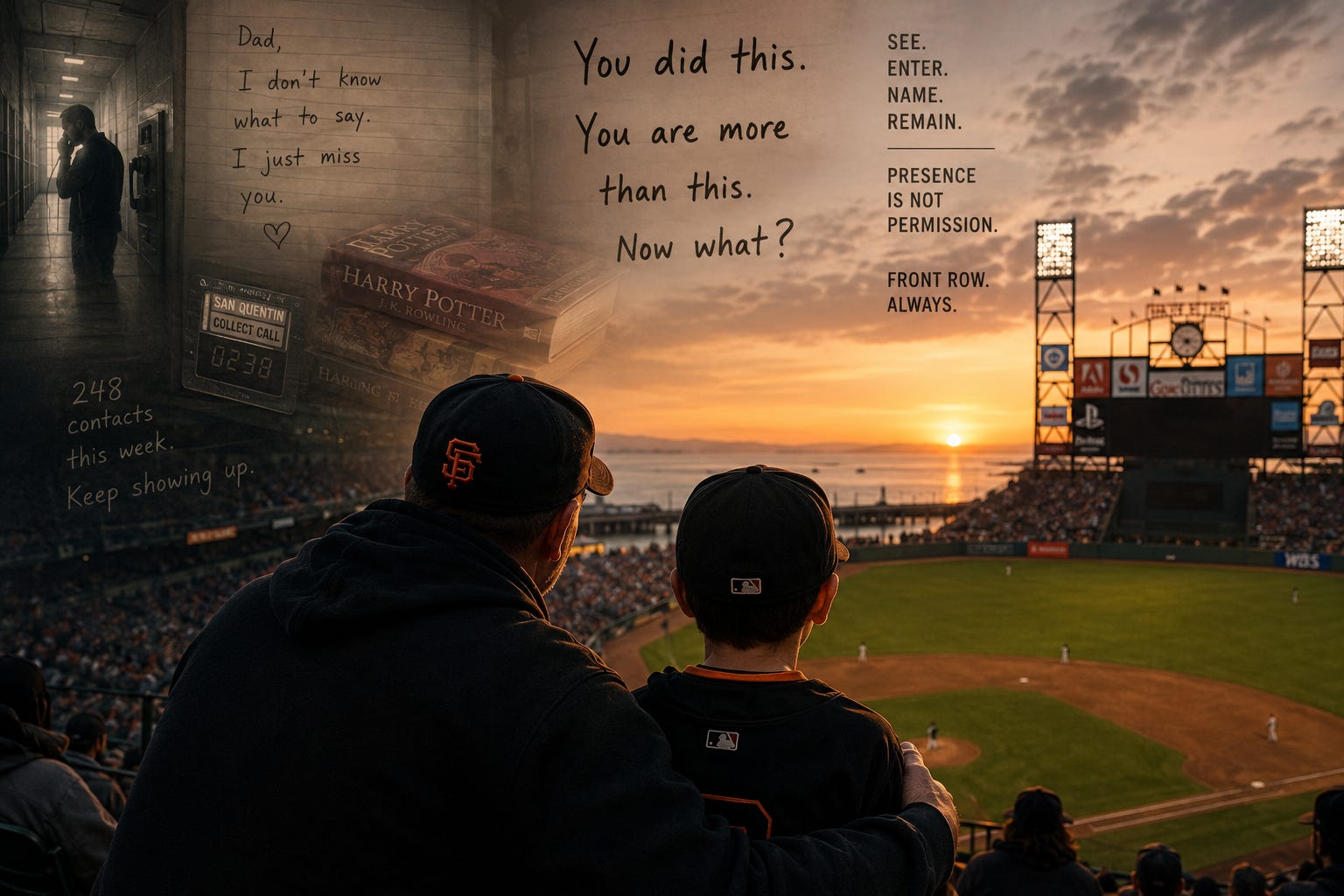
I was in San Quentin, living in a dorm with roughly two hundred men and a bank of four old telephones. A prison call does not begin like a normal call. A recorded voice announces where it comes from. The person receiving it must decide whether to accept the charge and the intrusion.
I sometimes felt like a ghost calling my former life. I could appear briefly and at a cost, but I could not enter the room.
Every unanswered call carried its own verdict. Each week that passed made me wonder whether I was becoming a story my son used to tell rather than a father he still had. I had done the thing that placed the distance between us. I knew that. What I did not yet understand was that knowing the cause of the distance did not tell me how to cross it.
I wanted to explain myself.
I wanted him to understand regret, consequence, remorse, and the strange dislocation of being alive inside a life you had damaged.
But he did not owe me the climb from his sixth-grade pain to my adult explanation.
The work was mine.
My son loved Harry Potter. He had read the books so many times that he once imagined setting a record. I went to the prison library and read every one.
I did not do this because I believed in wizards. I did it because he did, in the way children believe in stories that tell the truth without being factual.
The books gave us a language that did not begin with my crime.
The first time a call lasted because of Harry Potter, I understood something I had not understood before. He did not need me to explain prison. He needed one subject that did not make him brace. So we talked about Hogwarts, spells, houses, and which characters were braver than they looked. The conversation was not deep in the way adults measure depth. That was why it worked.
Later, I learned baseball because he loved baseball. After I came home, I bought an Xbox for my one-bedroom apartment and learned FIFA. I did not know the difference between a foul and a penalty.
I learned.
Years later, we went to Giants games together, often in standing-room seats or far from home plate. The seats did not matter. The shared attention did.
This is what I mean by meeting a person where they are.
It sounds gentle. It is not.
It asks you to admit that your preferred form of communication may be useless to the person you claim to love. It asks you to stop treating your insight as a gift the other person should be grateful to receive. It asks you to enter through the door they can open, not the one you keep pounding on.
Miller understood that humiliation is not discipline.
Fear is not respect.
Silence is not peace.
She also understood that we can examine the conditions that shaped destructive conduct without excusing the conduct itself. Even the person who later causes great harm was once a child. Seeing that child clearly does not erase society’s duty to protect others. Understanding explains. It does not acquit.
I have seen enough to know how rare that distinction is.