Apr 19, 2026
The Future Is Not Fixed 2of3
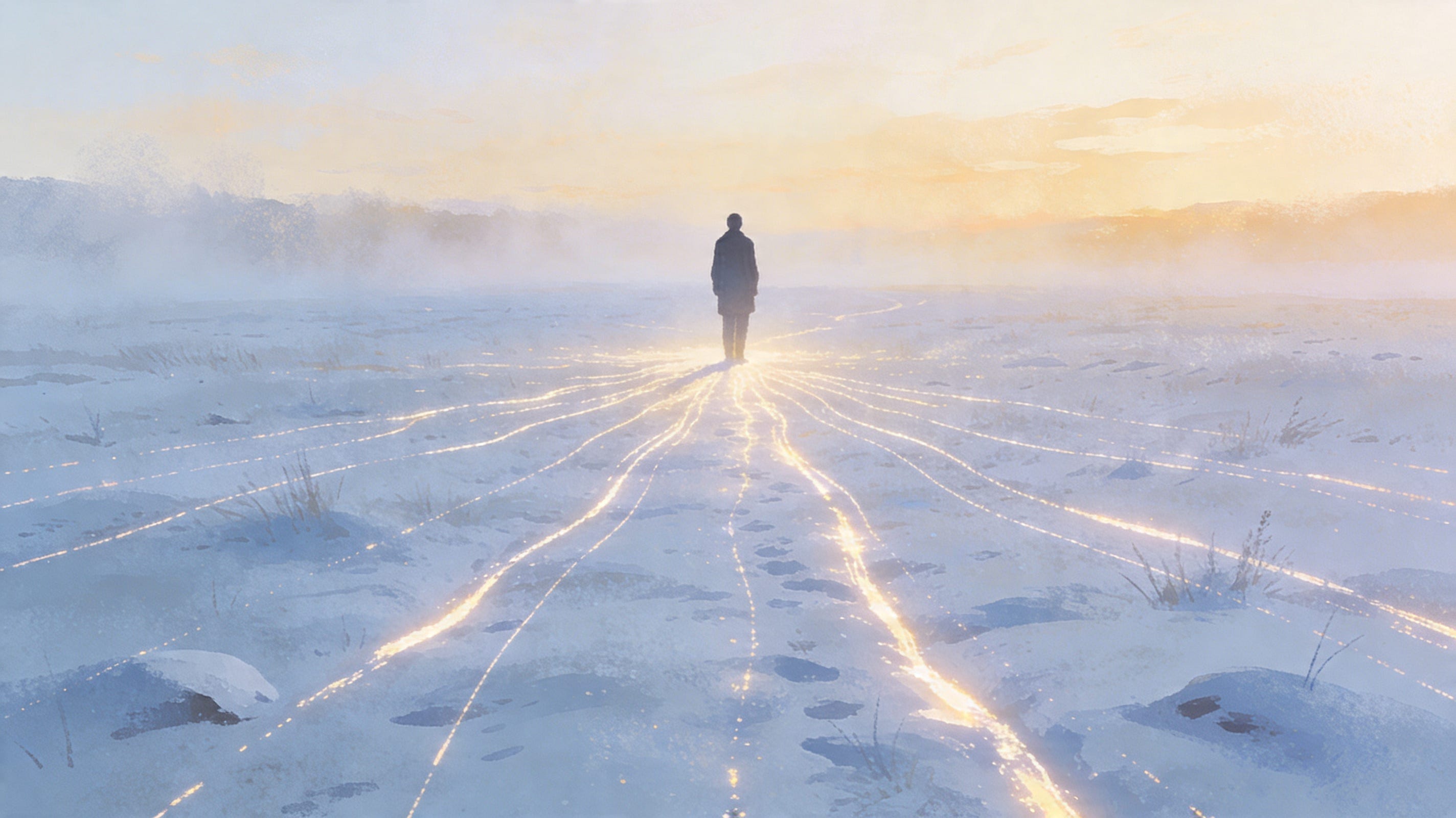
Time Is Not a Line
Most of us picture time as a line.
The past is behind us. The future is ahead. We move forward one moment at a time, as if reality were a track already laid and our job were just to ride it.
It is a useful picture. It is also, I think, the wrong one.
A better picture is this: time is not a line but a plane. A field. A spread of nearby possibilities under your feet.
Not empty space. Not chaos. A structured surface of live options, some close, some fading, some about to become unreachable depending on what you do next.
That is the image I want to give you. Not life as a railroad. Life as standing on a broad woven surface where more than one path is real, and where your next step matters because the ground is open.
The Old Picture Was Simple and Wrong
For a long time, the dominant picture of reality was basically mechanical. If you knew enough about the state of the universe now, you could in principle know everything that would happen next. The future, on that view, was fixed in advance. Your sense of choosing might feel vivid, but it was not doing any real work.
That picture still has a grip on people because it is tidy. It makes reality feel like a machine and time feel like a script.
Quantum mechanics broke that picture.
Not in a poetic way. In a technical one.
At the quantum level, reality does not behave as though every part of the future is already settled in the classical sense. A system can exist in a superposition of possible states. That does not just mean we are missing information. It means the physical description itself contains more than one live possibility.
And once you take that seriously, the image of time as a single line starts to fail.
The Better Picture Is a Plane
If the present is not fully settled all the way down, then the future is not a single prewritten destination waiting up ahead.
It is better pictured as a plane of adjacent futures.
Imagine standing on a wide snowfield before anyone has walked across it. There is no single path. There is a surface on which many paths can be made. Some routes are easier than others. Some lead somewhere better. Some look harmless and then get you lost. But the point is simple: the field is wider than the track you eventually leave behind.
That is closer to what I mean.
From the inside, we experience one path at a time. Of course we do. A human life is local. You are here, in this room, with this body, these obligations, this hour of the night, this text thread, this marriage, this deadline, this set of consequences. But the fact that experience is local does not mean reality is narrow.
The line is what it feels like from inside one lane.
The plane is the larger structure you are actually moving across.
Why We Only Experience One World at a Time
This is where decoherence matters.
You do not need the full technical apparatus here. The plain version is enough: quantum possibilities do not stay mixed forever. Interaction with the environment makes different outcomes separate enough that they stop behaving like one blended state and start behaving like distinct local realities.
That is why life feels singular.
Not because reality was always a single track, but because the branch you are in becomes the one you can actually inhabit, remember, and act within. Decoherence gives you a local world with stable records: this conversation happened, this promise was made, this harm was done, this chance was missed, this door is still open.
So the one-world feeling is real as experience. It is just not the whole ontology.
What Choice Actually Is
This matters because it gives us a better picture of agency.
Choice is not magic. It is not freedom from physics. It is not the power to conjure any future you want by force of feeling. That kind of language has done a lot of damage.