Apr 24, 2026
The Future Is Not Fixed: We All Have Free Will
[I have been working on different ways of expressing reality and free will. Here is another attempt to show we control our existence.]
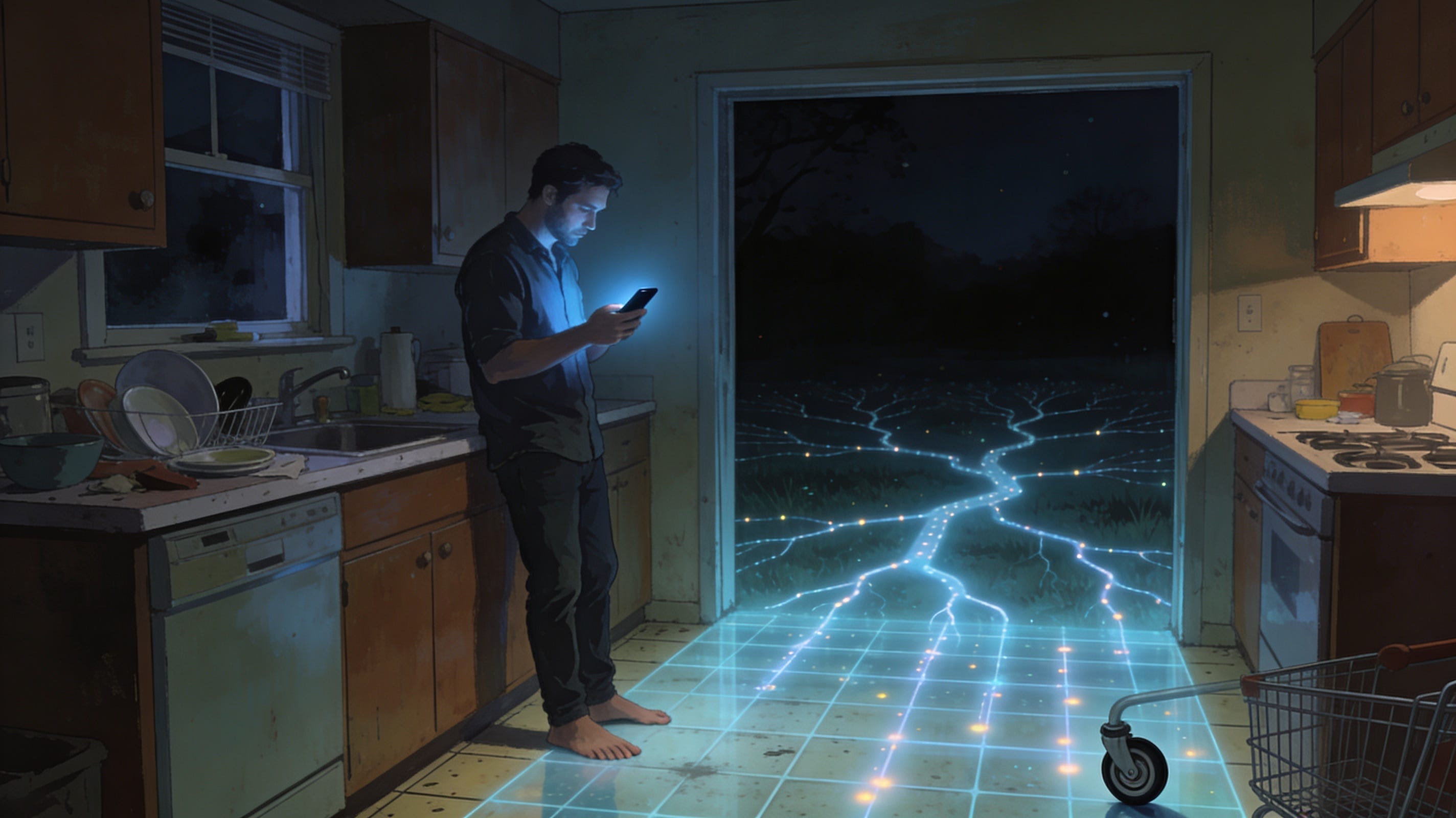
At 11:30 on a Thursday night, a man stands barefoot in his kitchen staring at his phone with the grave concentration of someone about to make his life worse in a way he’s workshopped before.
He has had a bad week, which is modern shorthand for at least seventeen failures of sleep, patience, metabolism and self-respect. He is tired, half angry, half hurt, and wholly convinced that one more text will finally clear things up. That belief has almost no evidence behind it, but that has never stopped anyone at 11:30 on a Thursday night. The history of the species suggests that late-night certainty is one of our less reliable gifts. As someone with a PhD in midnight texting, I can attest there is no Nobel for this kind of bravery.
On the screen is a draft message. Sharp. Defensive. Very articulate, in the way people become articulate when they are about to justify a bad idea to themselves and light a match in a dry field.
And there, in that ridiculous little kitchen with last week’s dishes, free will sidles in.
Not as thunder. Not as a glowing halo around the skull. Not as some cartoon power by which a man rises above physics and becomes a tiny god in sweatpants. Free will shows up smaller than that, and more serious. It shows up as the fact that more than one future is live from here, and his next move changes which one becomes his morning—whether he spends tomorrow apologizing or sleeping.
Most people were taught a cruder picture of reality. Time, they were told, is a line. The future sits out ahead like track already laid. You move along it. You do not make it. Newton built the machinery, Laplace supplied the fantasy, and generations of educated people fell in love with the idea that if some vast intelligence knew the position of every particle, it could read the future as easily as the past. It had a lot to recommend it. It was tidy. It was elegant. It flattered the rational mind and quietly demoted human choice to theatre—the sort of theatre where everyone is reading from a script but still thinks they’re improvising.
You could still feel dramatic, of course. People always do. But on that picture your decisions were just little speeches delivered by machinery on its way to an ending that had already been booked.
Then quantum mechanics came along and behaved with the bad manners of reality when it refuses to honor our favorite metaphors.
At the quantum level, the world does not sit there in one neat state waiting for us to discover it like car keys under a sofa cushion. A system can exist in superposition, which is physics’ way of telling the tidy‑minded that more than one live possibility can be present in the description of the world at the same time. Not because we are ignorant. Because reality is stranger than our old bookkeeping system allowed.
This is the point where people start to sweat and look for a nicer theory.
They like the equations. They do not like the implications. So they begin installing intellectual drywall. Maybe quantum theory is only about measurement. Maybe the weirdness stops at the lab door. Maybe there is some hidden mechanism underneath the math keeping reality respectable. Human beings have always been resourceful when asked to defend a comforting story from an inconvenient fact, and we’re very good at draping a scarf over a broken lamp.
But the bolder reading is also the cleaner one. Keep the equations. Stop apologizing for them. Let the world be as wide as the theory says it is. On that view, reality does not march forward on one track. It branches. The future is not a single destination waiting up ahead but a spread of adjacent possibilities, a woven field under your feet.
Which sounds exotic until you notice it explains something ordinary: why life still feels singular.
You do not wake up each morning with access to all possible worlds. You wake up in one room, with one body, one text thread, one bank account, one marriage or divorce or silence, one accumulation of promises kept and broken. The reason life feels like one world at a time is that the branching structure of reality produces local worlds with stable records. This happened. That was said. The door is still open. The harm was done. The apology was not offered. The check bounced. The child noticed.
This is where the argument gets interesting, because it is where people usually make a category mistake.