Apr 19, 2026
The Future Is Not Fixed 1of3
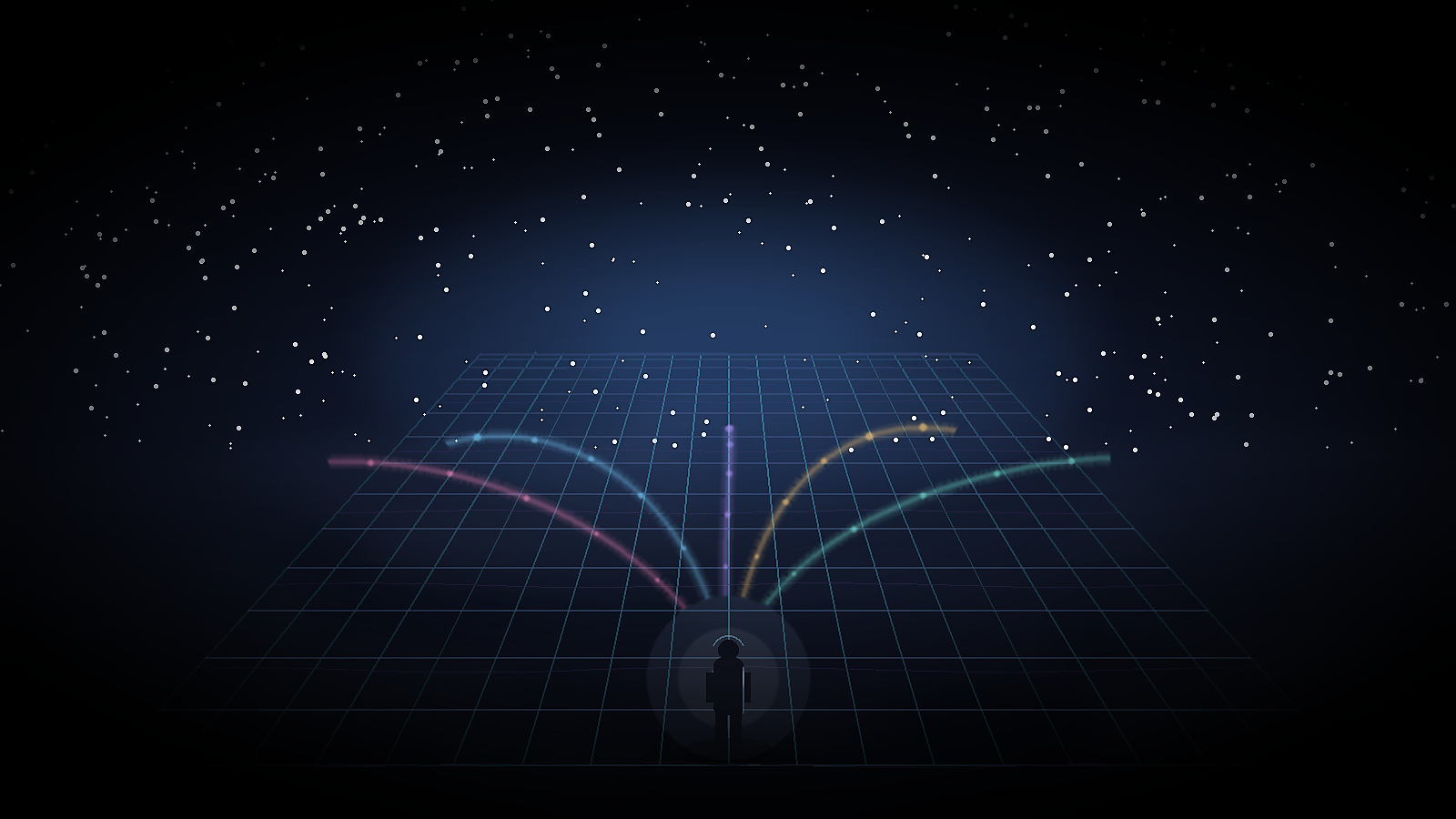
For centuries, educated people lived inside a simple picture of reality: the future was already there, waiting. Newton gave us the machinery. Laplace gave us the fantasy of perfect prediction. If a mind knew the position and motion of every particle, it could read the future as easily as the past. On that view, choice is theater. You do not author your life. You discover it too late.
Quantum mechanics broke that picture.
Not gently. Not at the edges. At the root.
A quantum system does not sit in one definite state while we wait to find it. Before measurement, it can exist in a superposition of possible states. This is not ignorance in the ordinary sense. It is not that the particle has already chosen a lane and we have failed to catch it. The theory says something stranger and harder: more than one outcome is physically present in the description of the world.
That is why the old deterministic picture no longer works. If the basic stuff of reality is not fixed in the classical way, then the future is not fixed in the classical way either. It is not merely unknown to us. In an important sense, it is still open.
Most people who write about quantum mechanics lose their nerve at this point. They treat the mathematics as solid and its implications as embarrassing. So they build fences around the weirdness. They say quantum theory tells us only what we can measure, not what is real. Or they add hidden machinery to force the world back into one tidy line. The motive is plain enough: a branching reality sounds absurd.
But absurdity is not an argument.
Hugh Everett took the equations more seriously than their custodians did. His idea was brutally simple: keep the math, drop the extra tricks. The Schrödinger equation applies to everything, all the time. There is no special moment when the world stops evolving smoothly and selects one privileged outcome. Instead, when different outcomes become possible, reality branches. Each outcome is realized in its own decoherent branch of the quantum state.
That sounds exotic. In practice, it explains something ordinary: why we experience one world at a time.
Decoherence is what makes the branches stop talking to one another. Once a system interacts with its environment, the alternatives no longer interfere in any useful way. They become effectively separate. That is why life feels singular even if reality is not. We live locally, in one branch, surrounded by records that make this branch definite: this room, this message, this wound, this promise, this hour of the night.
And that is where agency enters.