May 26, 2026
The Knife and the Story
This book (yes, I’m writing another one) opens with a simple insult: for most of your life, you have been living inside someone else’s idea of the truth. You cannot live without stories. You can learn to test them. This book teaches four acts: name the frame, cut the claim into premises, measure it against reality, and revise it when it fails. The chapters that follow are not apologies, but a record of how that happened, and of the tools of critical thinking you can use to quietly escape without anyone noticing, not even you at first.
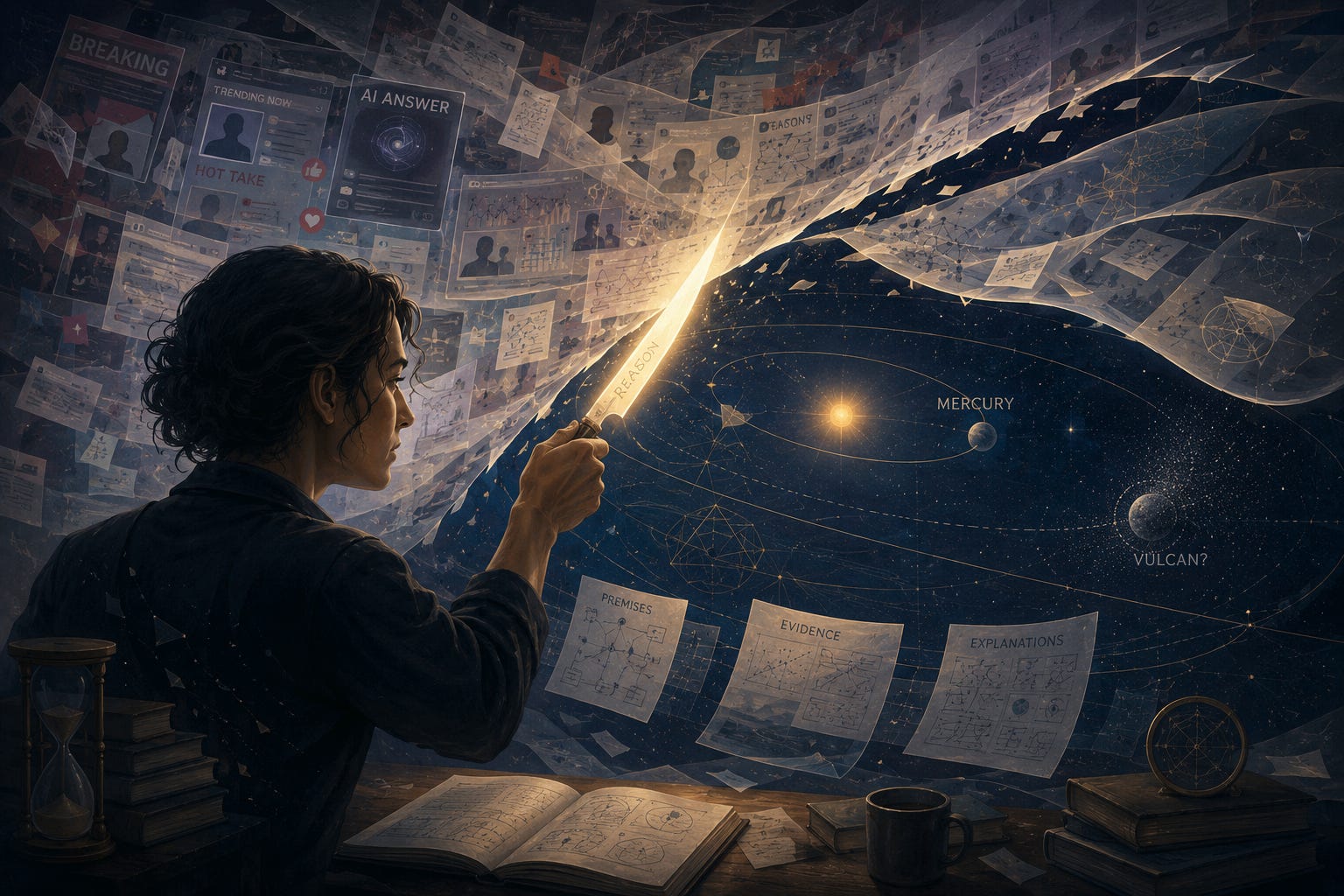
We live in an age where the great danger is not that you cannot find information. It is that you can find too much of it, too quickly, in forms that feel more complete than they really are. Dashboards, feeds, headlines, expert takes, social signals, and machine‑generated answers arrive with astonishing fluency, creating a strange new condition: people can feel informed while remaining unexamined. They can possess facts without ever touching the assumptions that give those facts meaning. Critical thinking, as it appears in this book, begins the moment you suspect that this might be happening to you.
Reality and the Stories We Put Around It
It is comforting to imagine that the universe is built from facts: solid, indifferent, waiting patiently for us to discover them. Yet the history of our known truths is not a clean march from ignorance to reason. It is a history of models that once seemed sufficient, anomalies that exposed their limits, and later generations inventing flattering stories about how easily error can be recognized from the outside. Crystalline heavens and invisible planets alike remind us that a belief can be orderly, defensible, and still wrong. Vulcan existed, for a time, not in the sky but in the collective imagination of people who were very sure they were rational.
The ships sailed, the planets moved, the light bent. None of that waited for our permission. What shifted was the quiet story behind the facts, the core narrative that decided which anomalies were curiosities and which were heresies. Critical thinking starts by dragging those narratives into the light. This book assumes something deeply uncomfortable: that you also inhabit such a narrative, and that it is more loyal to its own survival than to your well‑being.
Reality is not a story. Our access to it is shaped by stories, models, categories, and explanations. Critical thinking begins when we ask which explanation survives contact with what actually happens.
Not every story is tested in the same way. A scientific story must survive prediction and observation. A personal story must survive honest memory, consequence, and competing interpretation. An institutional story must survive the distance between stated values and actual behavior. A moral story must survive the question of what it permits us to do to other people. The Knife begins with one shared demand: before trusting a story, identify what kind of story it is and what evidence would count against it.
The Knife and the Neglected Beginning
Somewhere along the way, you were given a tool. You might call it logic, skepticism, or “being analytical,” but here it will simply be the Knife: the habit of cutting the world into pieces small enough to hold up to the light. Plato hinted at it in his art of measurement. Pirsig turned it into a razor that could split concepts finer and finer until only a manageable sliver of reality remained.
But a Knife is an ambiguous gift. It can carve away illusion, or it can refine your favorite delusions into polished arguments. A person can reason carefully from a false premise, build a beautiful plan on an undefined word, or construct a flawless model of a world that does not exist. For that reason, the first act of clear, critical thinking is not answering. It is pausing. Before you ask what conclusion follows, you must ask what has already been assumed. Before you argue over the right decision, you must ask what problem you are actually solving. Before you search for more data, you must ask whether the categories you are using are still valid. This neglected discipline of returning to the beginning runs through the chapters that follow.
Name the claim.
Cut it into assumptions and evidence.
Measure each assumption against competing explanations.
Update the story or retain it provisionally.
Provisional does not mean perpetually undecided. A frame deserves to be retained when it explains the available evidence better than its competitors, identifies what would count against it, and remains useful when action is required. The Knife is not a ritual of endless doubt. It is a method for earning commitment without confusing commitment with certainty.
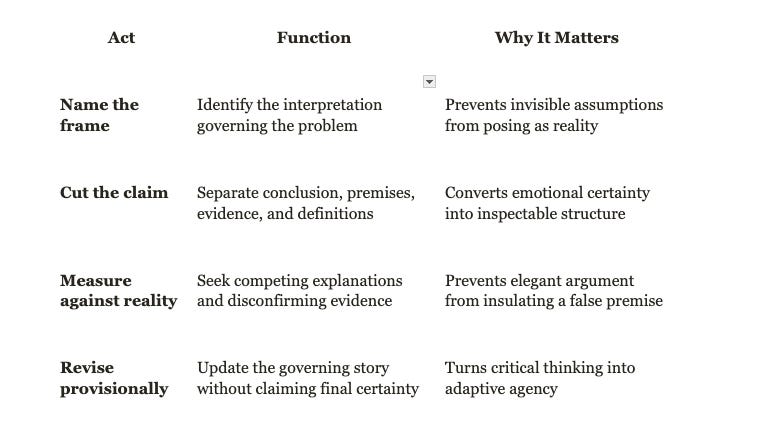
Vulcan offers the pattern in miniature. The claim was that Mercury’s orbit required another planet. The assumption was that Newton’s account of gravity was complete. The evidence was a real irregularity in Mercury’s motion. The competing explanation came from Einstein: the irregularity did not require a hidden planet, but a revised account of gravity itself. The failure was not observation. It was allegiance to the wrong explanatory frame.
Unlearning and Inspecting the Mental Furniture
Most people do not resist thinking because they are unintelligent. They resist it because real thinking threatens the comfort of inherited certainty. We forget that certainty is an emotion. Definitions arrive early, through parents, schools, professions, institutions, and social groups, and over time they become invisible. We stop saying, “I am using a particular frame.” We simply see through the frame and call what we see reality.