May 25, 2026
The Room That Changed
The DJ knew before the crowd knew that she had lost them.
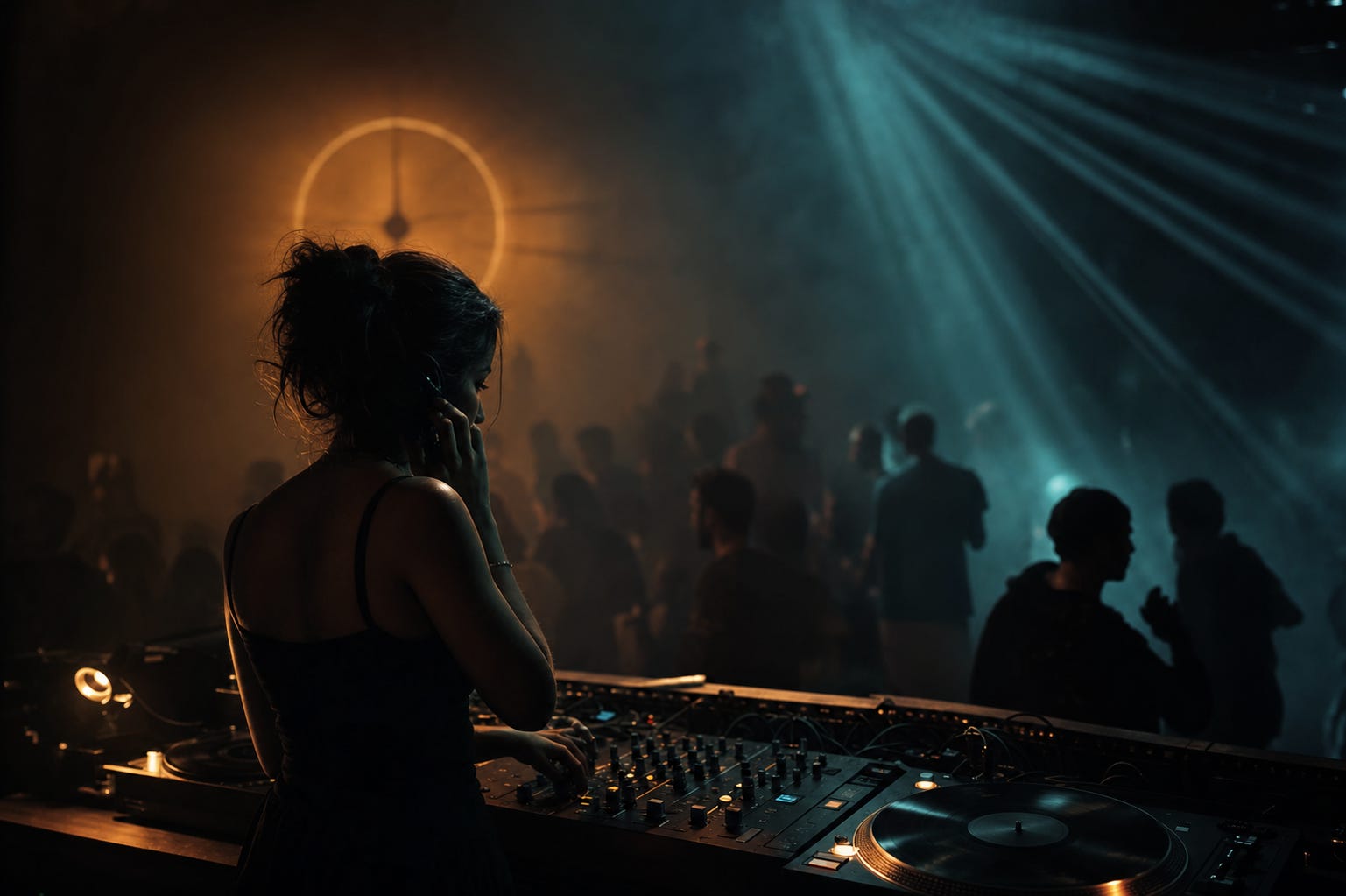
Or rather, the crowd knew first, but only with its body. A shoulder stopped moving near the bar. Two women who had been dancing without irony leaned toward each other and began speaking into the dark cup of noise between them. A man in a black shirt looked down at his phone as if the small blue square in his hand had become more interesting than the room he had paid to enter.
No one booed. That would have been cleaner. That would have given the failure a useful shape.
The room simply withdrew its belief.
From the dance floor, the booth looked like command. It had height, equipment, cables, light, and the small priestly drama of headphones pressed to one ear. It had knobs that promised mastery and screens that pretended the future could be seen in waves and grids. But from inside the booth, command was mostly an illusion. The DJ was not ruling the room. She was listening to it. Second by second, she was trying to distinguish hunger from habit, appetite from politeness, momentum from the dull obedience of bodies that had not yet admitted they were tired.
The mistake came from confusing those things.
She had chosen the next track because it should have worked. It had worked before. It had the right tempo, the right pressure, the right hidden machinery in the bass. It belonged, in theory, to the moment. But theory is a poor candle in a moving room. By the time the track arrived, the room had already changed. What had been waiting a minute earlier had become unwilling. What had been heat had become sweat. What had been surrender had become patience, and patience, in a nightclub, is a warning.
The Dance Floor as Moral Instrument
A dance floor is a crude but honest moral instrument. It has no interest in intention. It does not care what the DJ meant to play, what private theory of the room had formed in her head, or how beautiful the transition sounded in the small sealed world of her headphones. It registers only consequence.
That is why, in a world addicted to explanation, the dance floor can feel almost cruel.
It will not read your footnotes. It will not accept your reasons. It will not be persuaded by the story you tell yourself afterward. The dance floor receives the thing you actually did, and then it answers in the oldest language people know. It moves toward you. Or it moves away.
For a long time, before DJs became icons, brands, silhouettes against festival fire, they were custodians of attention. Their work was smaller and more dangerous than celebrity. They chose records in rooms where the wrong choice could not be hidden. They learned that a crowd is never one thing for very long. It is weather. It is appetite. It is memory. It is a beast with a hundred private griefs temporarily persuaded to breathe in rhythm.
The early selector’s gift was not omniscience. It was humility disguised as taste. She knew the record, yes, but more importantly, she knew the moment in which the record could live. She understood that music, like advice, like apology, like capital, like love, arrives either too early, too late, or in the brief trembling interval when the world can still receive it.
This is the part of the story we usually misunderstand. We like to imagine skill as control. We like the mythology of the hand above the room, the genius who bends chaos into form. But the better skill is stranger and less flattering. It is the skill of being corrected by reality quickly enough to remain useful.
The DJ booth is not a throne. It is a listening post.
This is true in clubs. It is true in conference rooms. It is true in marriages, negotiations, manuscripts, markets, and the late-night chambers of conscience where the mind keeps replaying the track it should not have played. Every life has a room. Every room has a temperature. Every temperature changes.
The trouble begins when we believe the room owes us the meaning we intended.
The Beautiful Shelter of Explanation
Afterward, the DJ could explain. Anyone could. The explanation would even be good. She could say the set needed lift. She could say the crowd had responded to that label earlier. She could say the transition was technically clean, which it was. She could describe the frequencies and the phrasing. She could point to the metrics available to her. She could make a handsome little case for her mistake.
This is what intelligent people do under threat. They build elegant shelters around simple injuries.