Apr 19, 2026
The Unfixed Future 3of3
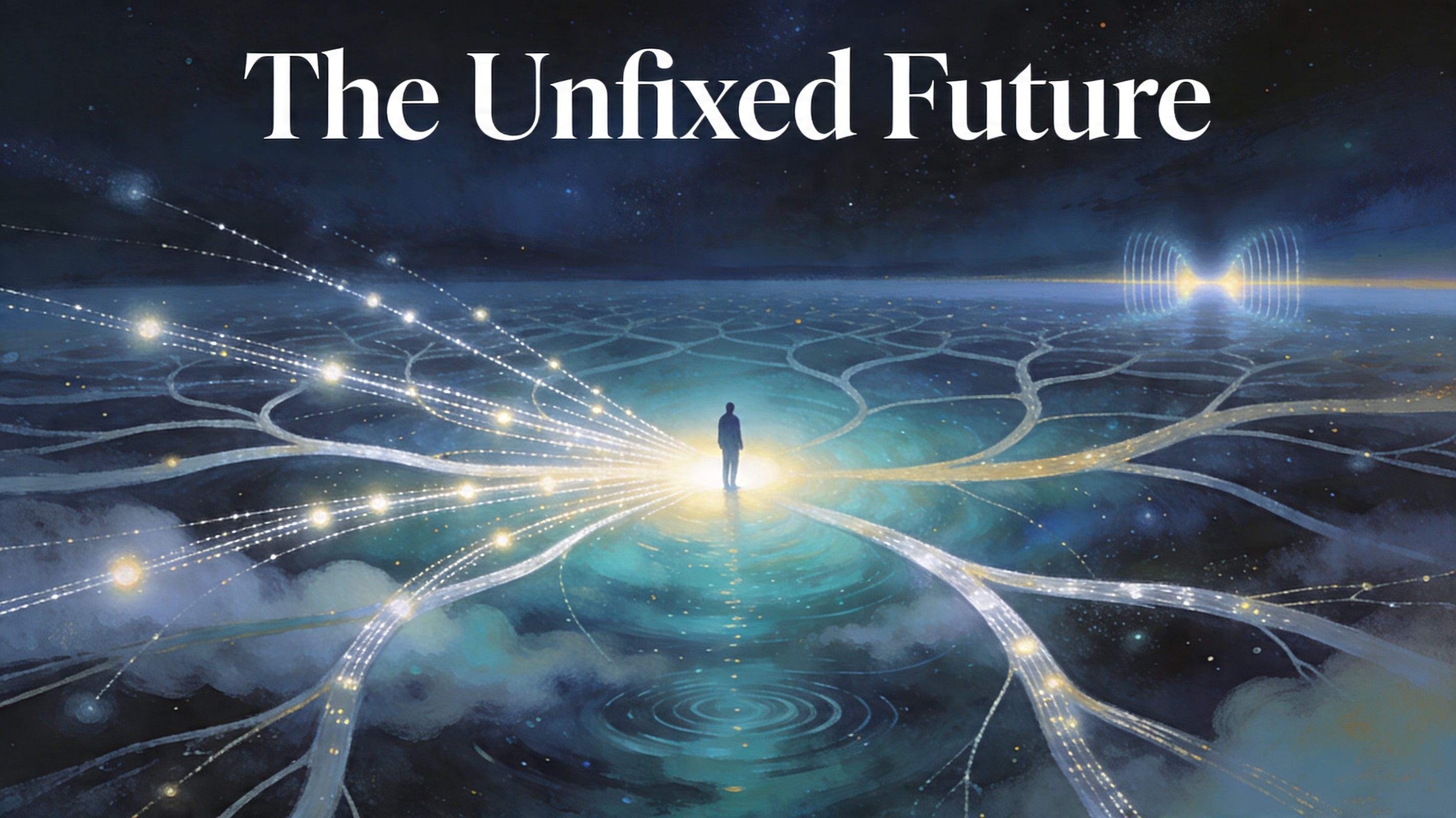
The Unfixed Future: A Position Paper on Quantum Reality, Agency, and the Open Plane of Time
Thesis
The future is not fixed. This is not a metaphor, a motivational slogan, or a philosophical preference. It is the most honest reading of our best physical theory. Quantum mechanics — taken seriously, without the philosophical contortions that flinch at its implications — tells us that reality branches. The universe does not march forward on a single track. It spreads sideways, a woven plane of branching possibilities, and which branch becomes yours is determined by the explanations you form, the policies you adopt, and the choices you make. Agency is real. The future is genuinely open. And understanding why — at the level of physics, not just sentiment — changes everything about how we inhabit our lives.
I. The Problem We Have Been Taught to Accept
For three hundred years, the dominant metaphysics of time was inherited from Newton and codified by Laplace: give a sufficiently powerful mind the position and momentum of every particle in the universe, and it can compute every future state with perfect precision. The future, on this view, is already written. You are a reader, not an author. Your sense of choosing is epiphenomenal — a story the brain tells itself about events already determined by prior causes. This is the “block universe,” where past, present, and future coexist as a fixed, four-dimensional slab, and free will is, at best, a useful fiction.
Quantum mechanics shattered this picture in the early twentieth century — and we have spent a century arguing about what to put in its place. The mathematics was clear: particles do not possess definite properties until they are measured. They exist in superposition, a precise mathematical object describing the simultaneous reality of multiple possible states. The equations governing this — the Schrödinger equation — are linear and deterministic. But the outcomes they predict are probabilistic. An electron is not in one place or another before you look. It is, genuinely, in both.
The philosophical establishment largely responded by refusing to take this seriously. The Copenhagen interpretation declared that quantum mechanics describes only what we measure, not what is real between measurements — essentially quarantining the weirdness behind a wall of epistemological humility. Others introduced hidden variables, collapse mechanisms, and consciousness-caused reduction of the wavefunction — each adding mysterious machinery to preserve the appearance of classical singularity The common anxiety beneath all of these maneuvers: if we take the math at face value, reality gets very strange.
The position of this paper is that the strangeness is the point. What quantum mechanics tells us, when read without flinching, is that the future is literally, physically open. The question is what kind of openness — and what it demands of us.
II. The Physics of the Open Future
Superposition Is Not Ignorance
The first move of this argument is to distinguish superposition from mere uncertainty. When we say a quantum particle is in superposition, we are not saying we don’t know which state it’s in. We are saying it is genuinely, physically in multiple states simultaneously. This is not a limitation of our knowledge; it is a property of the system. The evidence is decisive: interference experiments demonstrate that a photon traveling through two slits does not take one path or the other — it takes both, and the two paths interfere. The interference pattern cannot be explained if the particle was “really” in one state and we just didn’t know which.
Experiments on single photons confirm this non‑classical behavior: when light passes through two slits without any attempt to determine which path it takes, it produces alternating bright and dark fringes, but when physicists measure which slit the photon uses, the interference pattern vanishes. This shows that the pattern arises only when the particle effectively goes through both paths, and any which‑path information destroys the interference.
This matters enormously for any claim about the future. If a quantum system is currently in superposition across multiple possible states, and if the future state of macroscopic systems (including human brains, human choices, and human relationships) depends causally on the behavior of quantum systems, then the future is not merely unknown to us — it is undetermined in physical reality. There is, at this moment, no fact of the matter about which of several futures will obtain.
The Schrödinger Equation Does Not Collapse
The central technical claim of this paper draws from the Many-Worlds Interpretation (MWI), first formalized by Hugh Everett III in his 1957 doctoral thesis. Everett’s insight was radical in its simplicity: the Schrödinger equation always holds, everywhere, for everything. There is no special collapse mechanism. When a quantum system interacts with an observer, the observer — being a physical system — is themselves described by the Schrödinger equation. The result is that the combined system (quantum object + observer) evolves into a superposition of all possible outcomes.
The observer does not cause one outcome to become real while others vanish. Instead, the observer branches. Every outcome that was probabilistically possible occurs — each in its own emergent, effectively independent component of the universal wavefunction. Everett called these branches; David Deutsch, who has done more than anyone to clarify and defend this view, calls them parallel realities within a single quantum state. They are not separate universes causally disconnected from ours — they are components of one unified quantum description, made operationally separate by the process of decoherence. According to the Stanford Encyclopedia of Philosophy’s entry on the Many‑Worlds Interpretation, whenever a quantum experiment has several possible outcomes, all of those outcomes are obtained—each in its own emergent world.
Decoherence Creates Lanes, Not Walls
Decoherence is the process by which quantum systems interacting with their environment effectively lose the ability to interfere with one another. When a quantum system — say, a particle in superposition — interacts with the billions of particles in its surrounding environment, information about its state becomes encoded redundantly across those particles. This creates what physicists call “pointer states”: quasi-classical configurations that are stable, locally separate, and effectively independent of one another.
Physicist Wojciech Zurek calls these robust configurations ‘pointer states’ because they correspond to classically observable properties such as position or charge and can cause a measuring device’s needle to point to a particular outcome. Quantum superpositions, by contrast, cannot be copied; pointer states survive because the environment can imprint them repeatedly, allowing information about them to multiply across many fragments. The interference terms between them become vanishingly small.