Jun 23, 2026
Why Do So Many AI Transformation Projects Fail?
It usually is not because of the technology.
It is because organizations attempt to deploy artificial intelligence into environments that were never built for standardization, governance, accountability, clean data, or consistent execution.
AI does not fix disorder.
It accelerates whatever is already present.
If the culture is disciplined, AI scales discipline.
If the workflow is fragmented, AI scales fragmentation.
If leadership has never defined the standard, AI will expose that absence with speed and precision.
The marine industry gives us a fascinating case study.
This is an industry built on relationships, experience, local knowledge, entrepreneurial independence, and personal reputation. Those strengths matter. They are part of what gives the industry its character.
But they also create a hard problem.
Relationship-driven industries often resist standardization because standardization feels impersonal. Experienced professionals often resist workflow discipline because they believe their judgment is enough. Entrepreneurial businesses often resist governance because governance feels like friction.
Then AI enters the room.
And suddenly the weakness becomes visible.
AI cannot scale inconsistency.
It cannot automate fragmented workflows.
It cannot produce accountability where accountability has never been defined.
It cannot create culture where culture does not already exist.
This insight became one of the foundational themes in our upcoming book, Science of Selling: Boats & Yachts.
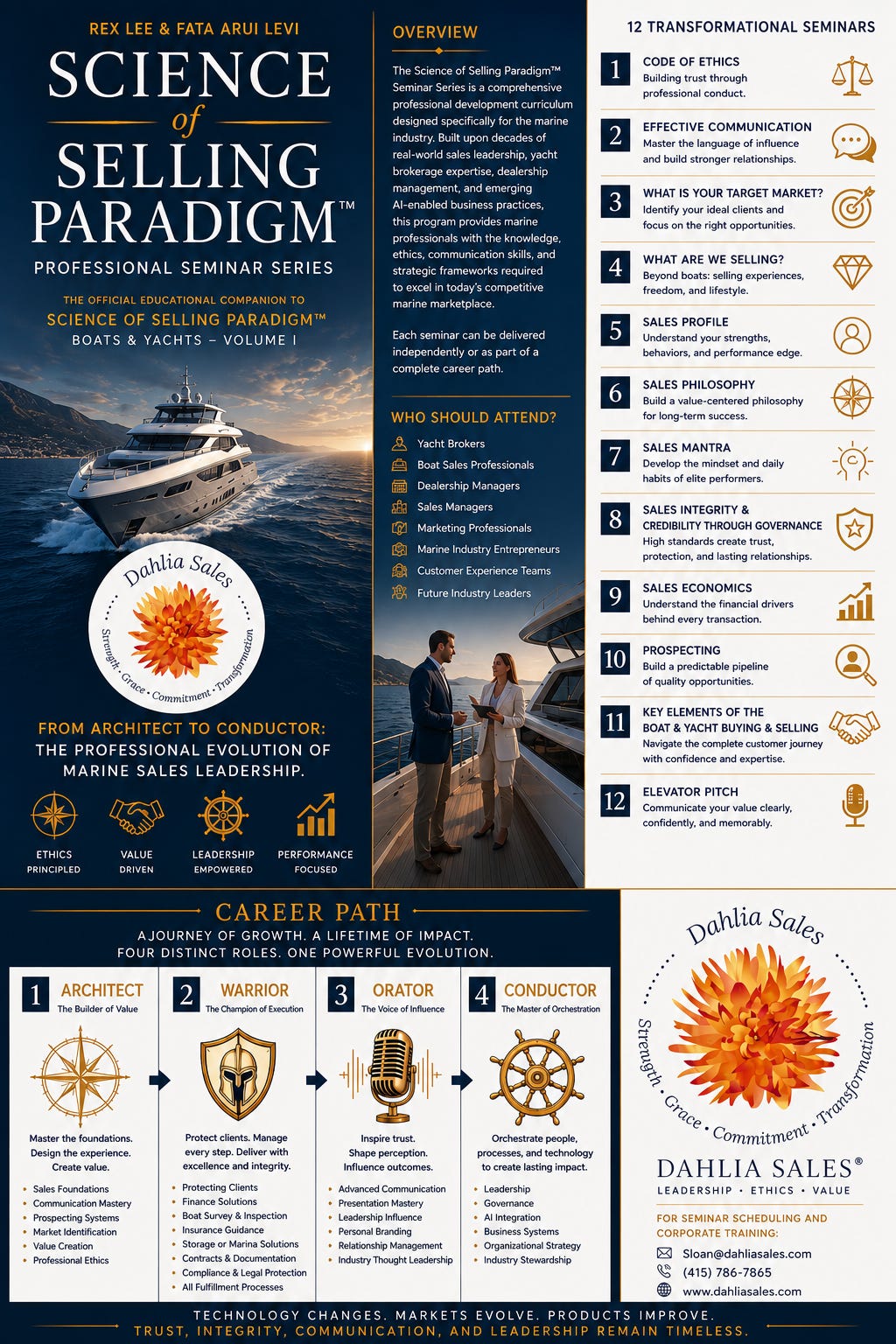
The book argues that successful AI transformation begins long before technology implementation. It begins with professional standards, documented best practices, workflow discipline, governance, and a culture capable of supporting change.
Technology may accelerate performance.
But culture determines direction.
That distinction matters because many leaders still confuse adoption with transformation. They buy tools, announce initiatives, schedule training sessions, and assume progress has begun.
It has not.
A tool without a standard is noise with a subscription fee.
In my work with the authors, I have approached this problem through three connected disciplines: Clear Thinking, Critical Thinking, and Strategic Thinking.
Clear Thinking asks whether the organization can regulate emotion under pressure. AI creates anxiety, status threat, overconfidence, and resistance. Some people fear replacement. Others rush toward novelty because they want to be seen as forward-looking. Both reactions distort judgment.
The first task is clarity: what problem are we solving, what decision must be made, and what human behavior must change?
Critical Thinking asks whether the organization has examined its definitions. What does “sales excellence” actually mean? What does “client service” require? What counts as a qualified lead? What information must be documented? What standard governs follow-up, disclosure, handoff, and accountability?
Bad definitions multiply. They become bad workflows, bad incentives, bad data, and eventually bad AI outputs.
Strategic Thinking asks whether the organization understands the long game. Marine sales is not a one-transaction game. Trust compounds through repeat clients, referrals, service relationships, reputation, and professional consistency.
A broker is not merely closing a sale.
A broker is protecting the client’s time, confidence, and future relationship with the water.
That is why Science of Selling: Boats & Yachts treats sales as a professional operating system, not a personality contest.
It connects leadership, culture, governance, workflow discipline, and AI into one central claim: the marine industry does not need AI theater. It needs the human and organizational foundations that allow AI to work.
The organizations that thrive in the AI era will not necessarily be the first to purchase AI.
They will be the first to become legible to AI.
That means clear workflows.
Clean data.
Defined standards.
Documented best practices.
Ethical controls.
Human oversight.
A culture that can learn without defending every inherited habit.
AI is not the transformation.
AI is the test.
This summer, Science of Selling: Boats & Yachts will explore how leadership, culture, governance, workflow discipline, and artificial intelligence can converge to establish a new professional standard for the marine industry.
The question is no longer whether marine organizations should use AI.
That question is too small.
The sharper question is this:
Are we preparing our organizations for AI, or are we simply purchasing technology and hoping it will forgive the disorder we refused to fix?